
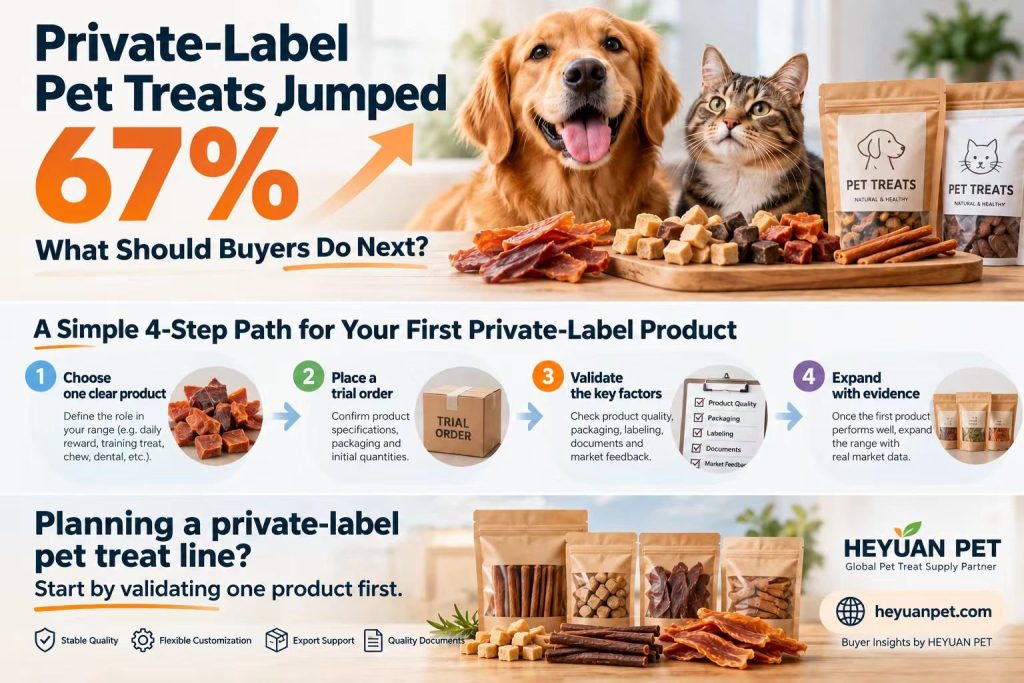
U.S. private-label pet treat unit sales jumped 67% in 2025.
The obvious response might be:
Launch more SKUs.
But that may be exactly the wrong move.
Recent industry data shows unusually strong growth in private-label pet treats. At the same time, private-label Pet Care as a whole recorded a 5.4% increase in unit sales in 2025.
For importers, distributors, retailers and private-label buyers, that creates opportunity — but it also creates a sourcing question:
When a category is growing quickly, should you expand faster — or validate more carefully?
Our view is simple:
Start with one clear product. Prove it. Then expand.
1. Define the product role before expanding the range
Before adding multiple SKUs, decide what the first product needs to achieve.
Is it intended as a daily reward?
A training treat?
A chew?
A dental-format treat?
Or a straightforward single-protein snack?
A clear product role makes supplier comparison, packaging decisions and price positioning easier.
2. Prioritize clarity over complexity
For an initial private-label launch, more differentiation does not automatically mean lower risk.
A product with a clear protein source, recognizable format and easy-to-understand use case can often be easier to test than a broad range launched at the same time.
The first trial order should answer one commercial question:
Will the target market accept this product consistently?
3. Use the first order as a validation cycle
A trial order is not only about checking the product itself.
It can also help buyers validate:
- product size and consistency;
- pack configuration;
- artwork and labeling;
- required documentation;
- retail presentation;
- and early market feedback.
Once these elements are stable, range expansion becomes a more informed decision.
4. Evaluate supply capability, not only the FOB quote
Price matters.
But long-term private-label sourcing also depends on whether the supply setup can support what comes after the sample.
Buyers should look at specification confirmation, packaging coordination, quality documentation, export documents, repeat-order consistency and future SKU expansion.
The goal is not simply to source one product.
It is to build a supply process that can continue working as the brand grows.
The Buyer Takeaway
The 67% increase is a strong signal.
But strong category growth does not mean every buyer should immediately launch more products.
A more controlled approach is:
Select one clear product → validate it → learn from the market → expand with evidence.
So before asking:
“How many SKUs can we launch?”
consider asking:
“Which one should we validate first?”
That may be the more valuable question before the first order.
HEYUAN PET International Business Department
Sources: PLMA 2026 Private Label Report; PetfoodIndustry reporting on private-label pet category growth, September 23, 2026.