
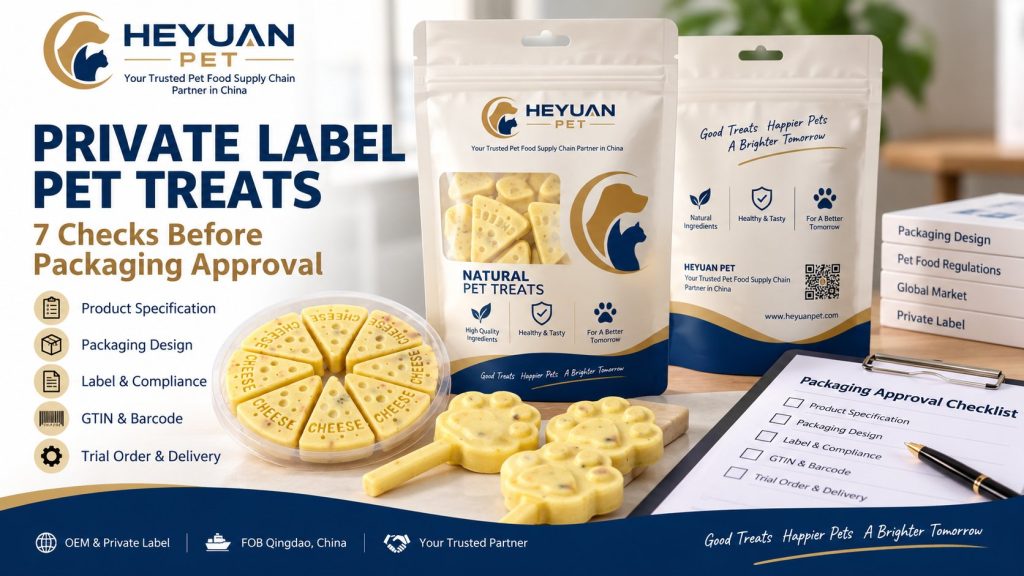
For international pet treat buyers, packaging is more than a design decision. In a private-label project, it connects the selected product with retail presentation, destination-market requirements, traceability, and import preparation.
Confirming the right information before final artwork approval can reduce revisions, avoid unnecessary packaging costs, and help move a trial order more efficiently from sample evaluation to production.
Here are seven practical checks for importers, distributors, brand owners, and other B2B buyers preparing a private-label pet treat project.
1. Confirm the Destination Market and Importer Requirements
The destination country should be identified before the label is finalized.
Import permits, health or veterinary documentation, product registration, label language, responsible-business information, and other requirements can vary by market and product composition.
The importer or its appointed compliance representative should therefore confirm the requirements applicable to the specific product and destination market.
For example, Singapore requires a Cargo Clearance Permit for commercial consignments of pet food, treats, and supplements. Products containing animal-origin ingredients may also be subject to additional import conditions depending on the product and source.
Buyer takeaway: Confirm the destination market early. Packaging should support the import process—not create a problem after printing.
2. Lock the Product Specification
The information printed on the package should correspond to the product actually being ordered.
Before artwork approval, confirm the relevant product information, including:
- Product name and item code
- Intended animal species
- Ingredient composition
- Relevant analytical information
- Product form and size
- Net weight
- Shelf life
- Storage conditions
- Feeding or usage guidance, where applicable
Any product or nutritional claims used on the packaging should be supported by verified product information.
Buyer takeaway: Approve the product first, then approve what the packaging says about it.
3. Confirm the Retail Pack and Shipping Configuration
A product MOQ and the number of finished retail packs are not the same thing.
The final packaging requirement depends on factors such as:
- Total order quantity
- Net weight per retail pack
- Packaging format and dimensions
- Number of packs per carton
- Number of products or artwork versions
- Packaging-material requirements
For illustration, 200 kg packed into 80 g bags corresponds mathematically to 2,500 packs before allowing for normal production and packing considerations. The same total product quantity packed into larger retail bags would result in fewer finished packs.
This is why pack size should be discussed early in a private-label trial order.
Buyer takeaway: Product quantity, retail pack size, and packaging requirements need to be evaluated together.
4. Decide Who Prepares and Approves the Artwork
A private-label project should clearly establish who is responsible for each part of the packaging process.
Before printing, confirm:
- Who owns the brand and artwork
- Who prepares the design files
- Who supplies the verified product information
- Who checks destination-market requirements
- Who reviews the final artwork
- Who provides written approval for printing
Production-ready artwork may also need to address technical requirements such as dimensions, bleed, colour settings, fonts, and barcode placement.
Buyer takeaway: A clear approval process reduces repeated revisions and helps keep the project moving.
5. Confirm GTIN and Barcode Responsibility
Barcode planning should be addressed before packaging is printed.
Under GS1 principles, responsibility for assigning a GTIN generally rests with the party responsible for the trade item—commonly the brand owner in a private-label project.
The appropriate GTIN treatment depends on the specific trade item and any changes made to it, so buyers should confirm the applicable GS1 requirements for their products and markets.
Before final printing, confirm:
- Who is responsible for the GTIN
- Which barcode file will be used
- Whether the barcode corresponds to the intended trade item
- Whether barcode placement and print quality are suitable for scanning
Buyer takeaway: Do not leave barcode decisions until after the packaging design is finished.
6. Review Packaging Against the Import and Commercial File
Packaging information and the documents supporting the shipment should describe a clear and traceable commercial product.
Depending on the order and destination, the relevant file may include:
- Product specification
- Ingredient information
- Commercial invoice
- Packing list
- Required health or veterinary documentation
- Other product or import-supporting documents
These documents do not necessarily use identical wording or contain identical fields. The important point is that the product identity and relevant information remain consistent, accurate, and traceable throughout the project.
Buyer takeaway: Packaging, product information, and shipment documentation should tell the same commercial story.
7. Use a Controlled Approval Sequence
A practical private-label trial-order process is:
- Select the product or product direction
- Identify the destination market
- Review samples and available product specifications
- Confirm the trial quantity and preferred retail pack size
- Check applicable importer and market requirements
- Prepare and review the artwork
- Confirm the GTIN and barcode requirements
- Provide written artwork approval
- Proceed with packaging and bulk-order preparation
The exact sequence can vary by project, but one principle remains useful:
Avoid approving final packaging before the product, market, and basic commercial configuration are sufficiently clear.
Preparing a Private-Label Pet Treat Trial Order with HEYUAN PET
HEYUAN PET supports international B2B buyers with pet treat supply, OEM & Private Label development, product and quality-document support, and FOB Qingdao, China export service.
For an initial project assessment, buyers can provide:
- Destination country
- Selected product or product direction
- Preferred retail pack size
- Expected trial quantity
- Brand and artwork status
- Required launch or delivery period
Current indicative starting parameters include:
- MOQ: 200 kg
- Samples: approximately 10 days
- Bulk order: approximately 30–40 days
- Export term: FOB Qingdao, China
Final project details depend on the selected product, packaging requirements, destination market, and confirmed order specifications.
Common Buyer Questions
How does MOQ relate to retail pack size?
MOQ refers to the product-order quantity, while the number of finished retail packs depends on the selected net weight and confirmed packaging configuration.
A buyer considering a trial order should therefore evaluate product quantity + pack size + packaging requirements together, rather than looking at MOQ alone.
For more detail, see our guide on what B2B buyers should check before ordering.
When should packaging artwork be finalized?
Artwork should normally move toward final approval after the selected product, destination market, pack size, key product information, and applicable importer requirements are sufficiently clear.
This helps reduce unnecessary revisions later in the project.
Who normally handles the GTIN for a private-label product?
Under GS1 principles, GTIN responsibility generally belongs to the party responsible for the trade item, commonly the brand owner in a private-label arrangement.
The applicable GS1 rules should be confirmed for the specific product and market before printing.
Ready to Discuss a Private-Label Trial Order?
Tell us your:
- Destination Market
- Product Direction
- Pack Size
- Trial Quantity
- Artwork Status
- Target Timeline
HEYUAN PET can then help organize the product, sampling, packaging, and export information needed for the next commercial step.
Discuss Your Private-Label Trial Order
Alternative actions: Request a Sample · Request a Quote