
Fish skin dog treats have become a steady category for private label buyers: single-ingredient positioning, recognizable sourcing, and formats that fit both premium and everyday chew lines. But for B2B buyers, the difference between a smooth sourcing project and a delayed one is rarely the product itself — it is how early the commercial details are confirmed.
This guide walks through the five checks worth completing before you request samples from a fish skin treat supplier, and how each one affects the private label decision that follows.
1. Start with the Ingredient Structure
The first check is the simplest one: what exactly is in the product?
Fish skin treats generally fall into two groups. Single-ingredient products are made from 100% fish skin — typically cod — with no additives. Composite products combine fish skin with other materials, such as cowhide, to create a different chew profile or price position.
Before comparing suppliers, ask for:
- The complete ingredient list, with percentages where applicable
- The fish species used (for example, cod) and the raw-material origin
- Whether any additives, preservatives, or flavorings are used
The ingredient structure determines how the product must be declared on your retail label, and it affects the documentation importers may need to provide. A supplier who can state this clearly at the inquiry stage is easier to work with at the documentation stage.
2. Match the Format to the Retail Concept
Fish skin treats come in several distinct formats, and each one fits a different shelf position:
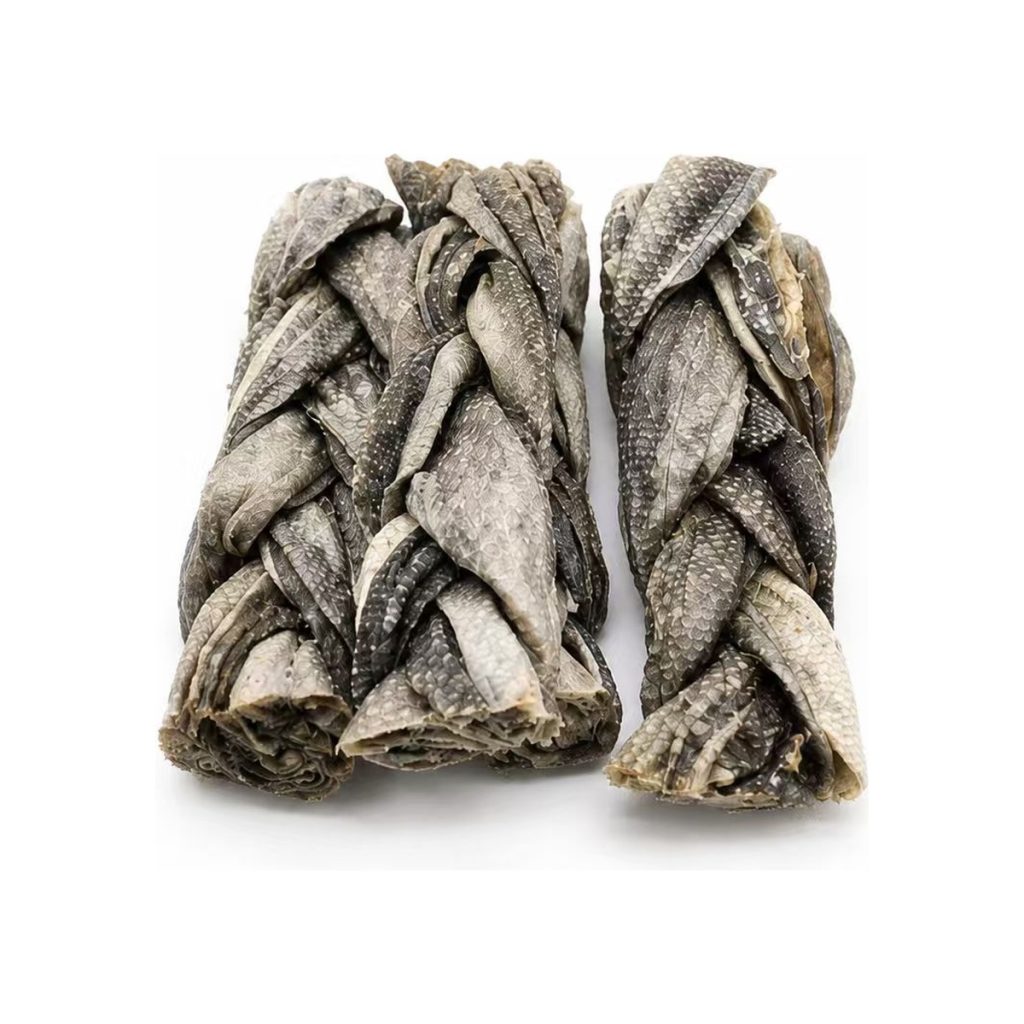
- Braids present the natural texture of the fish skin and suit a premium, single-ingredient display
- Sticks are simple, uniform, and easy to merchandise in standard treat bags
- Foamed rings and similar shaped formats add visual variety and work well in mixed treat programs
- Wrapped chews (fish skin wrapped around cowhide) position toward the longer-lasting chew segment
The format decision should follow your retail concept — target price point, bag size, and how the product looks on shelf — rather than the other way around. Confirming format early also narrows down packaging requirements, which directly affects private label planning later.
3. Confirm Specifications Before Comparing Quotations
Unit prices are only comparable when the underlying specifications are identical. Before requesting quotations from different suppliers, lock down:
- Nutritional specifications — for example, protein ≥60% and moisture ≤20% for single-ingredient fish skin treats
- Packaging format — retail bag weight (such as 80g), bags per carton, and carton dimensions
- Shelf life — 18 months is typical for dried fish skin treats
- Commercial terms — MOQ and trade terms (for example, FOB Qingdao)
Two quotations that look different on price may describe two different products. Fixing the specification first makes the price comparison meaningful, and it prevents re-quoted prices after sampling. For a wider view of how MOQ works in pet treat sourcing, see our guide on what B2B buyers should check before ordering.
4. Use Sampling to Evaluate Commercial Fit
Sampling is often treated as a final quality check, but for private label buyers it is better used as a commercial fit evaluation. When samples arrive, check them against the specification you agreed on, not just against each other:
- Does the physical product match the described format, color, and texture?
- Is the quality consistent across pieces in the same bag and across bags?
- Does the product fit the retail concept you planned — bag size, shelf presentation, target price?
Also use the sampling stage to observe the supplier’s working process: how quickly samples are arranged, how questions about specifications are answered, and whether documents match the physical product. These signals predict what the production stage will look like.
5. Plan Private Label Requirements Early
Private label is where late planning becomes expensive. If you intend to launch under your own brand, confirm the following before the trial order rather than after it:
- Bag artwork, languages, barcode, and required label declarations for your market
- Bag size and format compatibility with the product and carton
- Which documents the supplier provides — product specifications, ingredient information, and quality system documentation
- How the MOQ applies across the private label run, not just the standard product
Suppliers with structured OEM experience can align packaging design, specification documents, and order quantities in one pass. Buyers who leave these details until after production often face rework in labeling, repackaging, or documentation.
Explore Fish Skin Treat Options
HEYUAN PET’s current fish skin range includes:
- HY-022 Fish Skin Braid — 100% Cod Fish Skin
- HY-023 Fish Skin Stick — 100% Cod Fish Skin
- HY-024 Fish Skin Foamed Ring — Cod Fish Skin + Cowhide
- HY-025 Fish Skin Wrapped Cowhide Chew — Cod Fish Skin Wrapped Cowhide
All four formats are supplied with FOB Qingdao export service, OEM and private label support, and specification documents available on request. You can also browse the full fish skin treats selection.
Next Steps
If you are evaluating fish skin dog treats for a private label program, the fastest way forward is to define the product format and target market first, then move into sampling and quotation. Three ways to start: