
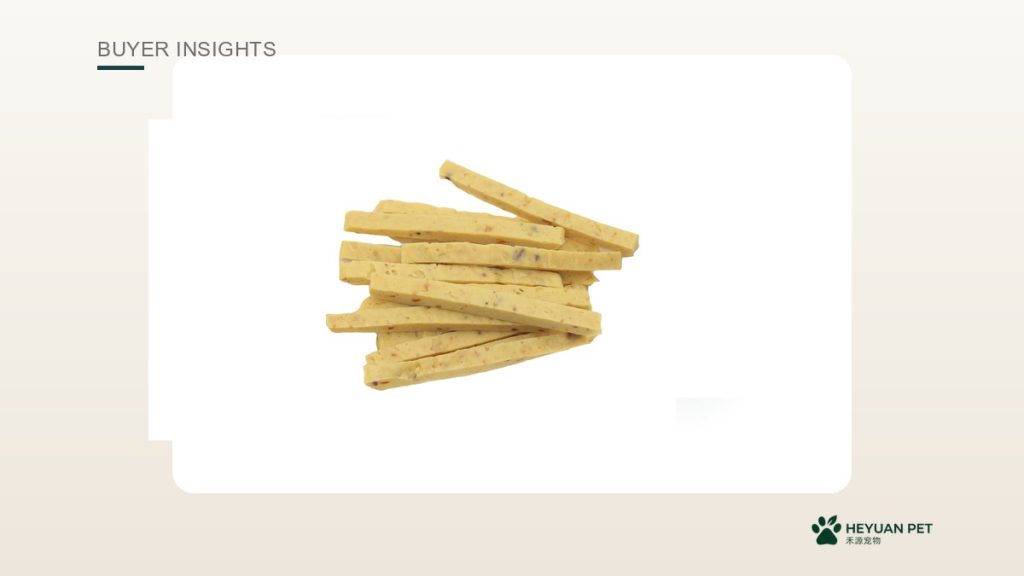
Cheese is an easy ingredient to sell and a surprisingly hard one to specify. When a retailer, a distributor or a pet owner further down the chain asks “how much lactose is in this treat?”, most supply chains cannot answer — not because the answer is secret, but because nobody asked the factory the right questions before the order was placed. This article is about those questions.
Why lactose comes up at all
Dogs do not all handle dairy the same way. Many dogs are lactose intolerant: they produce too little of the enzyme needed to digest lactose, the sugar in milk. According to the American Kennel Club (AKC), cheese and plain yoghurt are generally easier for dogs to digest than milk, but tolerance varies from dog to dog, and the common signs of a dog not tolerating dairy include loose stools, gas, vomiting and abdominal discomfort. The AKC’s guidance is general information, not veterinary advice, and it recommends checking with a veterinarian before introducing a new food.
Two things follow for a buyer. First, “contains cheese” tells your customer almost nothing — the type of cheese, and what happens to it in processing, decide how much lactose remains. Second, there is no single evidenced lactose figure that makes a treat suitable for every dog — tolerance is individual, and no measurement changes that. Anyone who promises otherwise is guessing.
“Cheese” is not one number
Lactose content differs enormously between cheeses. A 2020 review in the Journal of Translational Medicine (Facioni et al.) lists typical lactose contents for human foods, in grams per 100 grams:
| Food | Lactose (g/100 g) |
|---|---|
| Parmigiano-Reggiano (long-aged hard cheese) | under 0.01 |
| Cheddar | 0.5 |
| Cottage cheese | 3.2 |
| Ricotta | 3.5 |
| Whole milk, for comparison | 4.9 |
Most of the lactose leaves with the whey during cheesemaking, and long ageing reduces what remains even further — which is why the aged hard cheeses sit at the bottom of the table and the fresh, moist ones near the top.
Read those numbers carefully, though. They are reference values for human foods, not measurements of any pet treat. Brands and batches vary. And a cheese treat is a formulated product: the cheese is one ingredient among several, processed again, so the lactose in the finished treat is not simply the number in this table. That gap is precisely why the questions below belong in your order process, not in an after-the-fact email.
Question 1: Which cheese ingredient is used — and what is the measured lactose in the finished product?
Ask which cheese or dairy ingredient goes into the recipe, and then ask for the measured lactose content of the finished treat, in grams per 100 grams, with the test basis behind it: which laboratory, which method, and whether the value was measured on the finished product or only on the ingredient. A supplier with appropriate test records should be able to provide the measured result and explain its testing basis. A supplier without them will answer with adjectives — and adjectives are not a specification you can print, defend or repeat to your own customers.
Question 2: How do maturation and processing change the residual lactose — and can you show batch reports?
Cheese type is only half the story; the other half is process. Ageing time, whey drainage and the production steps after the cheese enters the recipe all move the residual lactose up or down. So ask how the factory’s process affects it, and whether the value from Question 1 holds from batch to batch. Batch test reports help show whether results are consistent across production batches. A written specification and an agreed testing plan provide a stronger basis for controlling that consistency. If reports exist, ask to see them before the order, not after the first complaint.
Question 3: What feeding and labelling wording do you support — and which claims will you not make?
The last question protects your label. Ask the factory what feeding guidance and label wording it supports for the product, in writing. Then ask the reverse: which claims does it refuse to stand behind? A responsible supplier will avoid claiming that a cheese treat is suitable for lactose-intolerant dogs. A measured lactose value helps describe the product, but it cannot establish that every dog will tolerate it. The final label and any product claims should also be checked against the requirements of the intended market — the supplier’s wording support does not replace the buyer’s own compliance check. Getting that boundary agreed before printing is far cheaper than correcting packaging, listings or customer communications afterwards.
Before you order: the written checklist
None of this requires new equipment or a long audit. It requires three questions, asked early and answered in writing:
- The cheese ingredient used, the measured lactose of the finished product (g/100 g), and the test basis.
- How maturation and processing affect residual lactose, with batch reports to show it.
- The feeding and labelling wording the factory supports — and the claims it does not.
A supplier who answers all three has given you a stronger evidence base for assessing product specifications, preparing label information and supporting customer conversations. A supplier who cannot has also told you something — before your money, and your customers’ dogs, are involved.
HEYUAN PET is a Weifang-based pet treat supply and export partner working with selected production facilities. We coordinate OEM and private-label supply, follow quality through production, and support export documentation — including getting questions like these answered in writing before an order is placed.