
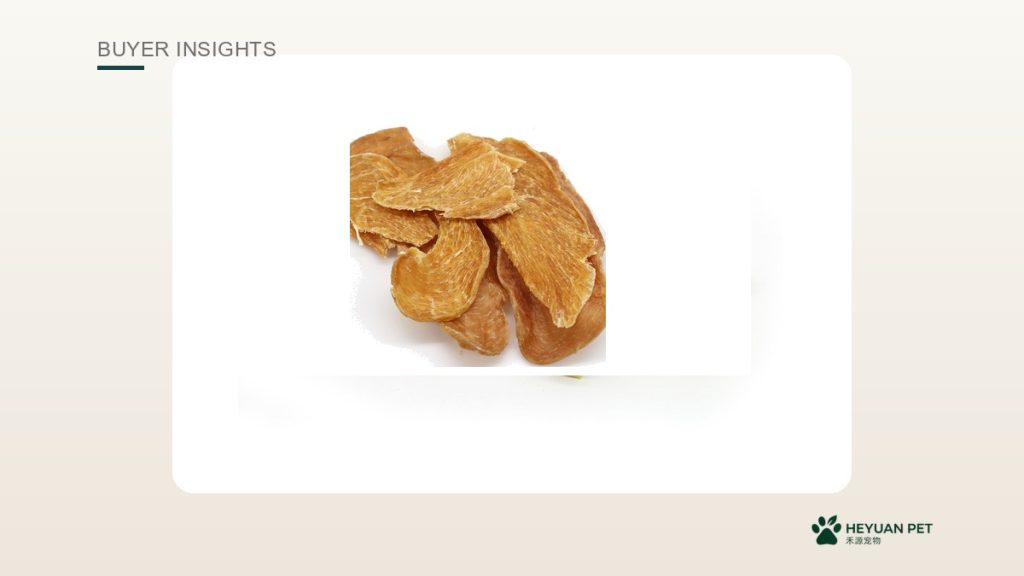
Buying pet treats from China for the first time usually starts with a price question. Price matters, but it is only one part of a successful first order. Most problems come from things that were never confirmed in writing: what exactly the product is, what a sample does and does not prove, which documents belong to which producer, and the exact point where the seller’s responsibility ends and the buyer’s begins. This guide walks through the process step by step, with the responsibility boundary stated at each step.
1. Start with the product definition, not the price
Before any quotation can mean anything, both sides need the same product on paper: the species and product form (for example, a chicken-based chew, a fish-skin treat, a dental stick), the pack format and net weight, and the quantity basis — per single SKU, or across several SKUs combined. These are different conversations. A price quoted against a vague description is not a price for your product; it is a number waiting to be renegotiated. Confirm the definition in writing first, and let the quotation follow it.
2. Samples and bulk are two different proofs
A sample proves a limited set of things: the formulation direction, the product form, the pack presentation. It does not prove bulk consistency.
Production runs involve different batches of raw material, full-line scheduling, and packing at volume. Treat the sample as approval of what the product should be — and check the bulk against it batch by batch, through inspection and batch documents, rather than assuming the sample guarantees the shipment.
3. Production and quality documents: ask what each one actually proves
Ask for documents, but read them for scope, not for reassurance.
A Certificate of Analysis (CoA) is a batch document. It reports test results for a specific production lot. It is evidence about that lot — not a universal guarantee for every future shipment.
A management-system or product certificate should be checked against what the certificate itself names: the certificate holder, the production site, the product and the scope it covers. It supports a claim within that named scope only. One producer’s certificate can never be used to support another producer’s product, and a certificate’s existence does not replace batch-level checking.
A serious supplier will tell you plainly which documents it can provide, which producer they belong to, and what they do not cover. That honesty is worth more than a thick folder.
4. FOB Qingdao, stated plainly
Under FOB Qingdao, Incoterms® 2020, the seller is responsible for export clearance, and the seller’s delivery obligation is completed when the goods are loaded on board the vessel nominated by the buyer at the named port of shipment. The risk transfers to the buyer at that point. This is the contractual delivery and risk-transfer point — not the day the goods leave the production facility or arrive at the destination port. The buyer arranges and bears the main sea carriage and destination-port import clearance. The agreed Incoterms version and named port should be stated in the sales contract.
Two practical consequences follow. First, “FOB Qingdao” is not “delivered to your warehouse”: the sea leg and everything after loading sits on the buyer’s side, arranged with the buyer’s own forwarder or agent. Second, insurance and transport arrangements should be planned against that on-board point — not against the day the goods leave the factory, and not against the day they arrive.
One important qualification: FOB is designed for sea or inland waterway transport where delivery takes place on board the vessel. If containerized goods are handed over to a carrier at a container terminal before loading, FCA may be the more appropriate Incoterms® rule. Buyers should confirm the actual delivery arrangement before selecting the trade term.
5. Put payment, inspection and release terms in writing before production
Before production starts, the commercial skeleton of the order should be written down and agreed by both sides: how payment is structured and when each part falls due, what inspection (if any) will take place and who arranges it, which shipping documents will be issued, and the exact condition for releasing the goods for shipment. None of this is controversial — but it must exist before, not after, the goods are made.
Terms reconstructed from chat messages in the middle of a shipment are how first orders stall at the port.
6. The destination side belongs to the importer
Import clearance is the buyer’s side of the line. The importer of record, the import classification, any import permits or product registrations, and the destination veterinary or food-safety requirements are handled by the buyer with its own customs broker. The exporter can share the product information and export-side documents it holds, but an export-side HS reference does not determine how the destination country will classify or admit the goods. Confirm your import eligibility and requirements with your local customs broker and the competent authorities in your market before the order is produced, not while it is on the water.
A written-confirmation checklist for your first order
Before production, you should be able to point to written agreement on:
- Product definition: species, form, pack format, net weight, quantity basis.
- Sample approval: what was approved, and what it does not cover.
- Documents: which batch and producer documents will be provided, and their scope.
- Trade term: FOB Qingdao, Incoterms version and named port in the contract.
- Payment structure, inspection arrangement, and shipment release condition.
- Destination side: your importer-of-record status, classification, and clearance path confirmed with your broker.
None of these steps is complicated. Together, they are the difference between a first order that was hoped for and one that was actually agreed.
HEYUAN PET is a Weifang-based pet treat supply and export partner working with selected production facilities. We coordinate OEM and private label supply, follow product quality through production, and support buyers with export documentation — on FOB Qingdao terms.