
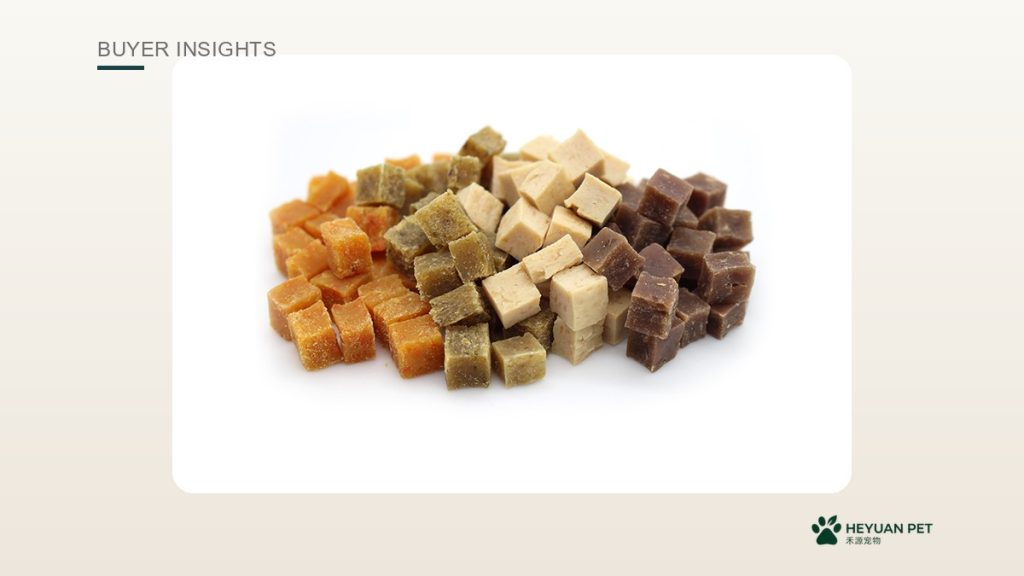
One question buyers often ask is: “Can we start with 500 bags?” It is a reasonable question — and the honest answer rarely has much to do with willingness. It has to do with what it physically costs to set a production line in motion. If you source private label pet treats, it helps to know that an MOQ is not one number. It is three separate logics that are often quoted as one — and each of them can be planned around once you see it separately.
1. Production MOQ: the fixed cost of starting a line.
Before a pet treat line produces its first bag, it has to be set up for that product: changeover, cleaning, calibration, trial runs. Those steps cost about the same whether the run that follows is small or large, and all of that fixed cost lands on the first batch. That is why every production run has an economic batch size. Below it, the setup cost is spread across so few units that the per-bag cost climbs steeply; above it, the curve flattens. A production MOQ is the point where the economics of the line start to work. It is set per product and per SKU, by the setup the line requires — not by sales policy.
2. Packaging MOQ: a separate, printing-side logic.
Custom-printed bags follow their own minimum logic, independent of production. Printing plates are made for your artwork; how plate and printing costs are charged varies by supplier, and the specific charges are subject to the supplier’s confirmed quotation. A print run also carries its own setup economics. This is where trial orders most often get stuck: the production quantity may be perfectly workable while the custom-print quantity is not there yet. The two minimums solve different problems, and treating them as one number hides the practical way through. Where confirmed feasible by the supplier, standard packaging with labeling may offer a practical option for initial orders. Custom printing then moves to the repeat order, when volumes support it. So ask about the packaging minimum separately — it is a different question from the production MOQ, and it has a different answer.
3. Order quantity and price: the shape of the curve.
Under otherwise comparable conditions, larger production quantities may help distribute fixed costs across more units. Actual pricing remains subject to the confirmed quotation. In practice, this produces a curve rather than a slogan: unit prices typically step down as quantity grows, and the steps get smaller as the fixed costs are absorbed. A supplier who can show you that ladder, quantity by quantity, is giving you something more useful than a promise — a way to choose where on the curve your first order should sit.
Before you plan a trial order, ask three questions.
First: is this MOQ counted per SKU, or per order? Confirm the minimum production quantity required for each SKU before planning a trial order. How SKUs are scheduled in production depends on the supplier’s actual production conditions — confirm it with the supplier, SKU by SKU, and do not assume one factory’s conditions apply to another. Second: does the packaging carry its own minimum, separate from production? Third: can I see the price ladder before I decide the quantity?
Two practical paths buyers use at the pilot stage follow from this: start on standard packaging with labeling where the supplier confirms it is feasible, and — for quantities below the minimum — ask whether samples or a small validation batch are feasible, rather than forcing them into production pricing.
MOQ is more than a number. It’s the shape of the line — and a partner who shows you the curve before you order is worth more than one who just says “yes” to every quantity.
HEYUAN PET coordinates OEM and private label pet treat production in Weifang, China — chicken, duck, fish skin, cheese and dental treats — with quality follow-through from sampling to shipment. If you are planning a trial order, tell us the product and the quantity you have in mind. We will check both against confirmed production and packaging conditions, and give you a plain answer on what is feasible.
— HEYUAN PET International Business Department